
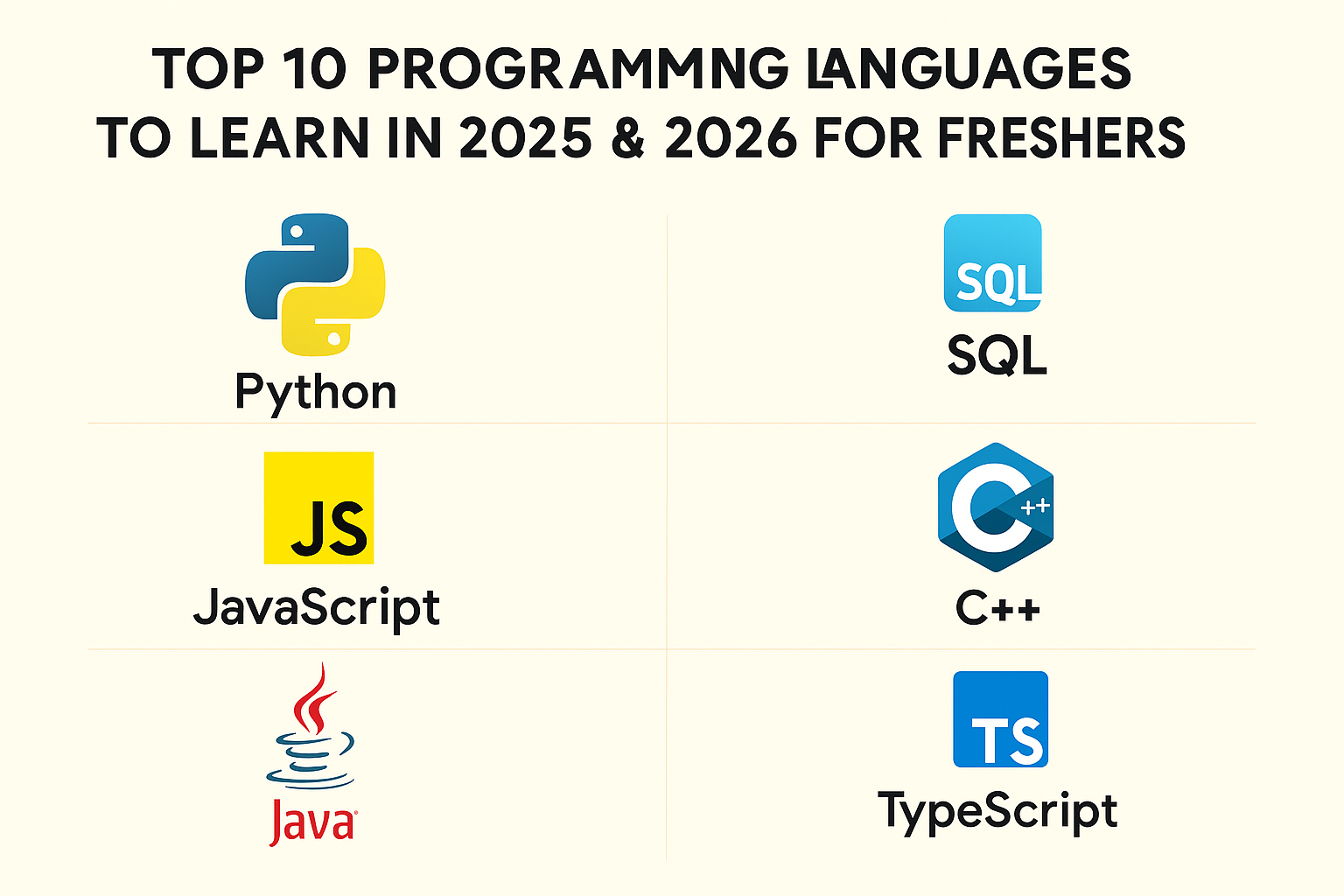
Top 10 Programming Languages to Learn in 2025 & 2026 for Freshers
Published: 13-09-2025 at 09:08 pm

Choosing the right programming language as a fresher can shape your career path. With AI, Web3, IoT, Cloud Computing, and Cybersecurity booming, companies are looking for candidates who can adapt to both classic and emerging technologies. Here’s a list of the top 10 programming languages to learn in 2025 and 2026, with real-world use cases and examples to guide you.
Why Learn?
Python is simple, beginner-friendly, and one of the most versatile programming languages. It powers AI, Data Science, Machine Learning, Web Development, Automation, and IoT.
Where It’s Used:
AI & ML → ChatGPT, Google AI models are built with Python.
Web Apps → Instagram, YouTube backend uses Python frameworks like Django & Flask.
Automation → Companies automate repetitive office tasks with Python scripts.
Example:
A fresher joining a startup can use Python to build a data dashboard using Pandas and Streamlit for real-time sales analytics.
Why Learn?
JavaScript makes websites dynamic and interactive. It’s everywhere – from front-end to full-stack web development.
Where It’s Used:
Websites → Facebook, Twitter, and Gmail heavily rely on JavaScript.
Mobile Apps → Frameworks like React Native allow building iOS & Android apps.
Server-side → Node.js is used for scalable backends.
Example:
An e-commerce site can use JavaScript + React for a fast, responsive shopping experience while Node.js handles payments at the backend.
Why Learn?
Java remains the backbone of enterprise software, Android apps, and large-scale banking systems. It’s highly stable and secure.
Where It’s Used:
Android Apps → WhatsApp, Spotify’s Android versions use Java.
Banking/FinTech → Used by banks for secure backend systems.
Big Data → Frameworks like Apache Hadoop use Java.
Example:
A bank’s fraud detection system might use Java + Spring Boot to monitor millions of transactions per second.
Why Learn?
C++ is crucial for system-level programming, gaming engines, and applications requiring high performance.
Where It’s Used:
Game Development → Unreal Engine is built in C++.
Operating Systems → Windows, macOS, Linux kernels use C++.
Embedded Systems → Used in cars, medical equipment, and IoT devices.
Example:
Tesla’s autopilot system relies on C++ for real-time decision-making in vehicles.
Why Learn?
C# is widely used in Microsoft environments, cloud solutions, and Unity game development.
Where It’s Used:
Game Development → Unity games like Pokémon Go use C#.
Desktop Apps → Microsoft Office and Visual Studio.
Cloud Apps → Azure cloud apps use C#.
Example:
A gaming startup could build a VR/AR game in Unity with C# scripting.
Why Learn?
Every company needs data. SQL (Structured Query Language) is the backbone for querying and managing databases.
Where It’s Used:
Business Intelligence → Analysts use SQL to extract insights.
Websites & Apps → Any app with a login/signup uses SQL databases.
Big Data → Tools like Snowflake and Google BigQuery support SQL.
Example:
A fresher in an analytics role may write SQL queries to track customer purchase patterns for an e-commerce site.
Why Learn?
Developed by Google, Go is fast, simple, and perfect for modern cloud-native applications.
Where It’s Used:
Cloud Infrastructure → Docker and Kubernetes are built in Go.
Web Servers & APIs → High-performance backend APIs.
AI & ML → Used for scaling AI-based microservices.
Example:
Netflix uses Go to handle millions of concurrent requests, ensuring smooth streaming worldwide.
Why Learn?
Rust is known for speed, safety, and memory management. It’s replacing C/C++ in many areas.
Where It’s Used:
WebAssembly → Runs C++-like code in browsers.
System Programming → Microsoft and Meta are adopting Rust.
Blockchain → Solana blockchain is built with Rust.
Example:
A fintech company might use Rust to build secure blockchain wallets with zero memory leaks.
Why Learn?
Kotlin is Google’s preferred language for Android app development. It’s concise and interoperable with Java.
Where It’s Used:
Android Apps → Apps like Pinterest and Trello are Kotlin-based.
Server-side → Works with Spring Boot for web backends.
Cross-platform → Kotlin Multiplatform supports iOS + Android.
Example:
A fresher developer could build a ride-hailing app like Ola using Kotlin for Android development.
Why Learn?
TypeScript is JavaScript with superpowers – type safety and scalability. Big companies prefer it for large projects.
Where It’s Used:
Large Web Apps → Microsoft Teams, Slack.
Front-end Frameworks → Angular is written in TypeScript.
Backend APIs → NestJS (server-side TypeScript).
Example:
An enterprise may use TypeScript + Angular to build a secure HR management system.
For freshers in 2025 & 2026, the must-learn combo would be:
Python + SQL → For AI, Data Science, and Automation.
JavaScript + TypeScript → For full-stack web development.
Java or Kotlin → For Android & enterprise apps.
Go or Rust → For future-proofing skills in cloud, blockchain, and system-level programming.
👉 The key is not just learning one language but combining 2–3 complementary languages based on your career goal.